Import, export and repository snapshot
The Import/Export page lets you bulk-import objects from a CSV file, export any object type to CSV, and commit a point-in-time backup of every monitor and application to your version-control repositories.
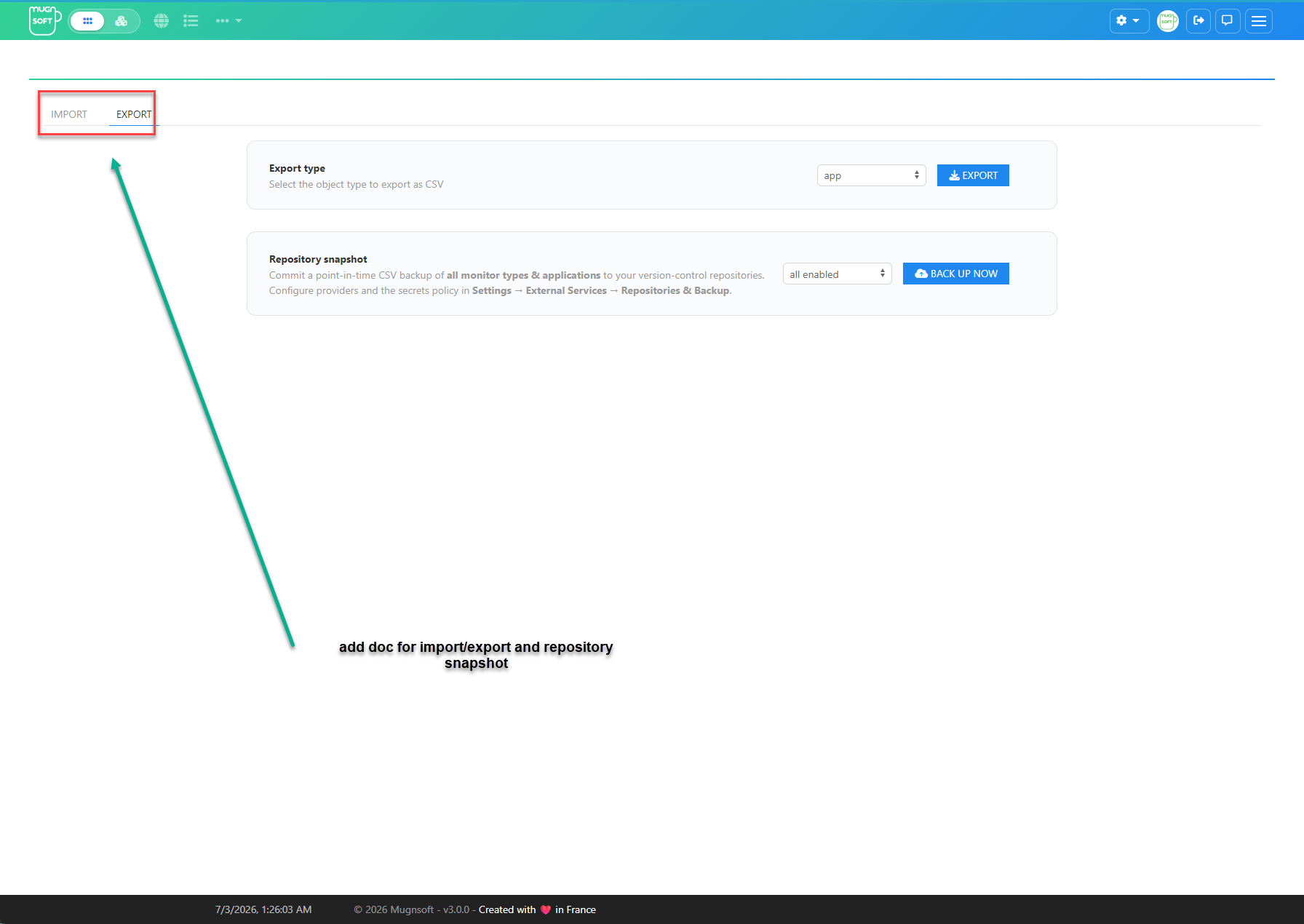
The page is split into two tabs: Import and Export. The Export tab also hosts the Repository snapshot action.
Note:
Import
Import objects in bulk from a single CSV file.
- Open the Import tab.
- Drag & drop a CSV file onto the drop zone, or click browse to pick one.
- Upload starts automatically; a progress bar and status message report the result.
The object type (api, db, nslookup, ping, tcp, sys, snmp, wmi, url, app, host, snmp device, wmi device) is detected from the file content, so you do not select a type when importing.
CSV format:
- Field separator is a semicolon (
;). - Lines starting with
#are treated as comments and ignored. - The file must contain at least one data row.
Tip:
Export
Export a single object type to CSV.
- Open the Export tab.
- In Export type, select the object type (app, api, db, nslookup, ping, sys, tcp, url, snmp device, wmi device, host).
- Click Export. The CSV is generated and downloaded as a zip archive.
Repository snapshot
The Repository snapshot card commits a point-in-time CSV backup of all monitor types and applications to your configured Git repositories, in one batch commit. Use it to version-control your monitoring inventory or to keep an off-box copy for disaster recovery.
- In Repository snapshot, choose the target:
- all enabled — commit to every configured and enabled provider.
- GitLab — commit to GitLab only.
- GitHub — commit to GitHub only.
- Click Back up now.
The snapshot writes one CSV per monitor type plus an applications CSV and a manifest.json, under a monitors/ and applications/ folder in the repository.
Note:
Configure the Git repository
Providers and the secrets policy are configured in Settings → External Services → Repositories & Backup. Two backends are available: GitLab and GitHub. Configure one or both.
GitLab
| Field | Description |
|---|---|
| GitLab Namespace | Group/namespace that owns the repository. Required so monitor scripts are saved correctly. |
| GitLab Token | Personal or project access token with repository write scope. |
| Gitlab base URL | API base URL, e.g. https://my-gitlab.com/api/v4. |
| Gitlab project name | Target project (repository) name. |
| Gitlab branch | Branch to commit to, e.g. dev. |
Use the test (bolt) icon to verify the connection. The synchronize icon reconciles the GitLab repository with the current Mugnsoft monitor list and deletes files that no longer belong to any monitor.
GitHub
| Field | Description |
|---|---|
| GitHub Owner | User or organization that owns the backup repository. |
| GitHub Token | Personal access token with repository write scope. |
| GitHub repository name | Target repository, e.g. mugnsoft-monitors. |
| GitHub branch | Branch to commit to, e.g. main. |
| GitHub base URL (Enterprise) | Leave empty for github.com; set your GitHub Enterprise base URL (e.g. https://github.mycorp.com) otherwise. |
Use the test (bolt) icon to verify the connection and the synchronize icon to reconcile the repository with the current monitor list.
Include secrets in CSV backups
Each provider panel has an Include secrets in CSV backups toggle. It is a shared policy that applies to both GitLab and GitHub.
Note:
After filling in the fields, enable the provider and save the settings. The provider then becomes selectable in the Repository snapshot target list.