Components operations
This section describes operations related to Mugnsoft components.
Below are the three main components of a Mugnsoft infrastructure.
- MNS Webserver: The Webserver is the component that manages the whole infratrsucture and data. Components (a.k.a. Servers), Monitors, Reports, Downtimes, Users are managed through the Webserver WebUI. It bundles its own API interface that starts up at the same time as its webUI.
- MNS Monitor: A probe is the component in charge of executing the business transaction scenarios, URL and API checks. It exposes an API interface.
- MNS Integrator: An Integrator is the component in charge of integrating the business transaction scenarios, URL or API data to external products. It exposes its own API interface.
The Components page
Open it from the gear menu → components, or #/server. It draws the whole Mugnsoft infrastructure as a topology: the Webserver at the top, the Sentinel agents and the probes grouped beneath it, the Integrators they forward to, and the external services (SMTP, Slack, InfluxDB…) each one uses. Every node is coloured by its health; a disabled component is grey, and the edges show which component talks to which.
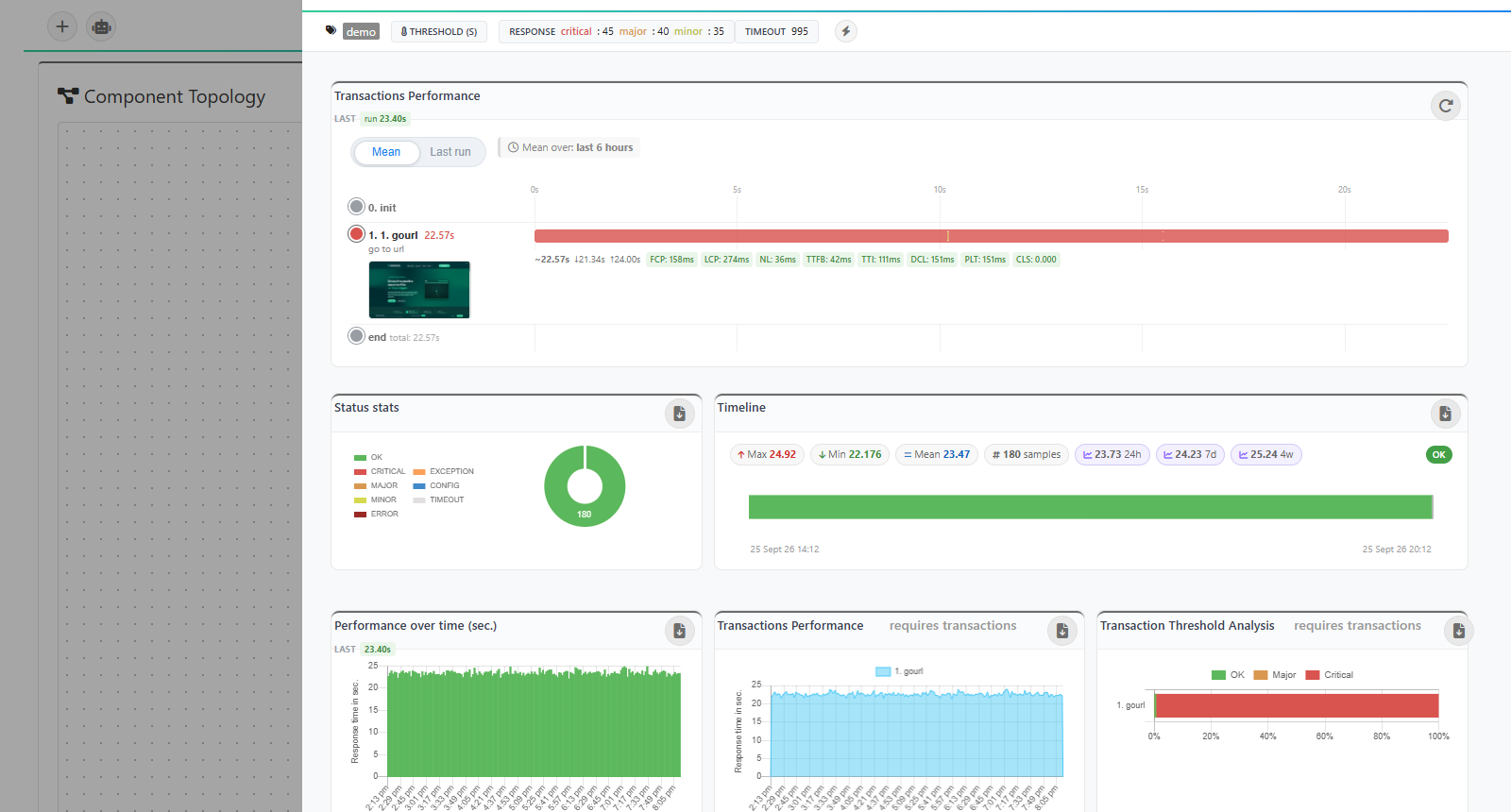
Use the search box above the graph to find a node (type:pattern works, e.g. type:monitor), the refresh button to redraw it, and ? for the legend.
The toolbar above it holds actions that apply to every enabled component at once:
| Button | Action |
|---|---|
| + | Add a component. See Add a component. |
| robot | Build a component configuration with AI. See Component config builder. |
| archive | Trigger the KV store backup on all enabled remote servers. |
| brush | Purge stale STATUS data on all enabled remote servers. |
| two arrows | Resynchronise the access token of all servers. |
| circular arrow | Reload the Webserver SSL certificates folder. |
| refresh | Refresh the servers list. |
| grid | Toggle the table view. |
Add a component
- Click +.
- Fill in the General tab: a unique Server Name, the Server Type (monitor, integrator, sentinel agent…), its IP, Port and OS, an optional description and location, and whether it is Enabled. The backup and log settings have sensible defaults.
- Click the disk icon to save.
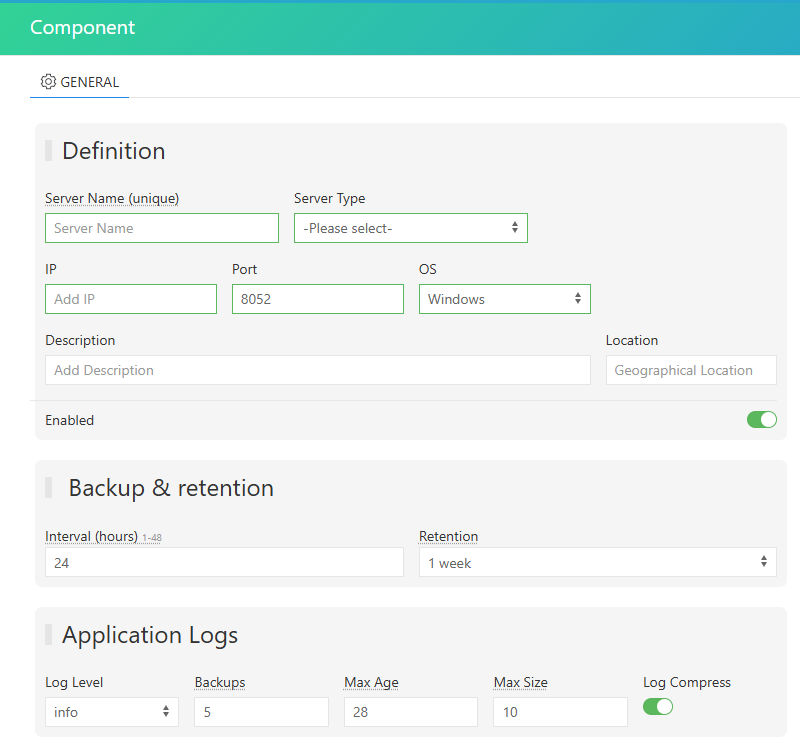
The new component appears in the topology. Components that register themselves (see Log in for the first time) appear without this step.
Available operations
Right-click a node to open its menu. The menu lists only what applies to that component type: a probe offers compute threshold and purge stale STATUS data, a Sentinel agent offers discovery map, run discovery and compute threshold, the Webserver cannot be deleted.
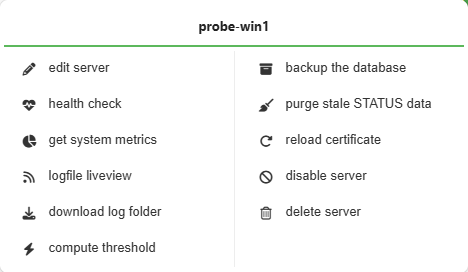
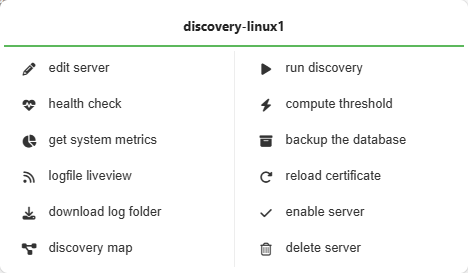
| Menu item | What it does | Components |
|---|---|---|
| edit server | Open the component’s settings. See Edit component. | all |
| health check | Call the component and report whether it answers; the result is shown in a notification. | all |
| get system metrics | Open the CPU and memory charts. See Component metrics. | all |
| logfile liveview | Stream the component’s log. See Live view. | all |
| download log folder | Download the component’s log folder as an archive. | all |
| discovery map | Open the agent’s discovery map. | Sentinel agent |
| run discovery | Start a discovery run now. | Sentinel agent |
| compute threshold | Recompute the thresholds of every monitor on this component from its history. | probe, Sentinel agent |
| backup the database | Back up the component’s KV store now. See Backup. | all |
| purge stale STATUS data | Remove status records left by monitors that no longer exist. | probe |
| reload certificate | Reload the component’s SSL certificates folder. | all |
| enable server / disable server | Change the component’s state. A disabled component is no longer contacted. | all |
| delete server | Remove the component, after a confirmation. | all but the Webserver |
While an action runs, the node shows a spinner; its outcome is reported in a notification at the bottom right.
Component metrics
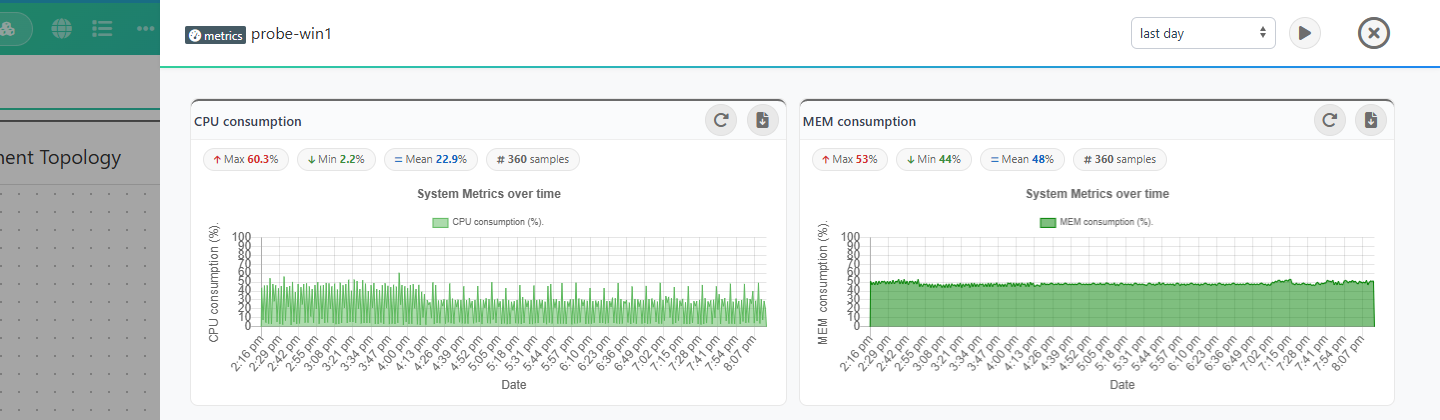
get system metrics opens a side panel with the component host’s CPU and memory consumption over the selected range (last day by default), each with its max / min / mean and sample count. Change the range at the top right and click the play button to reload.
Live view
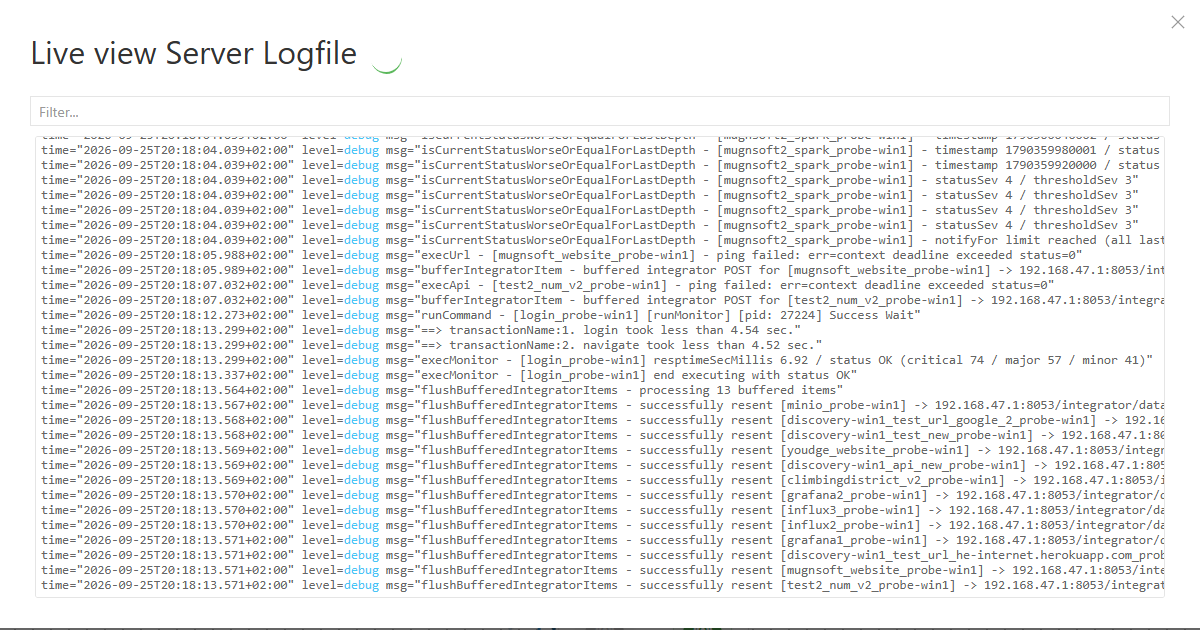
logfile liveview streams the component’s log file into a window and keeps refreshing it while it is open. download log folder downloads the whole log folder instead.
Edit component
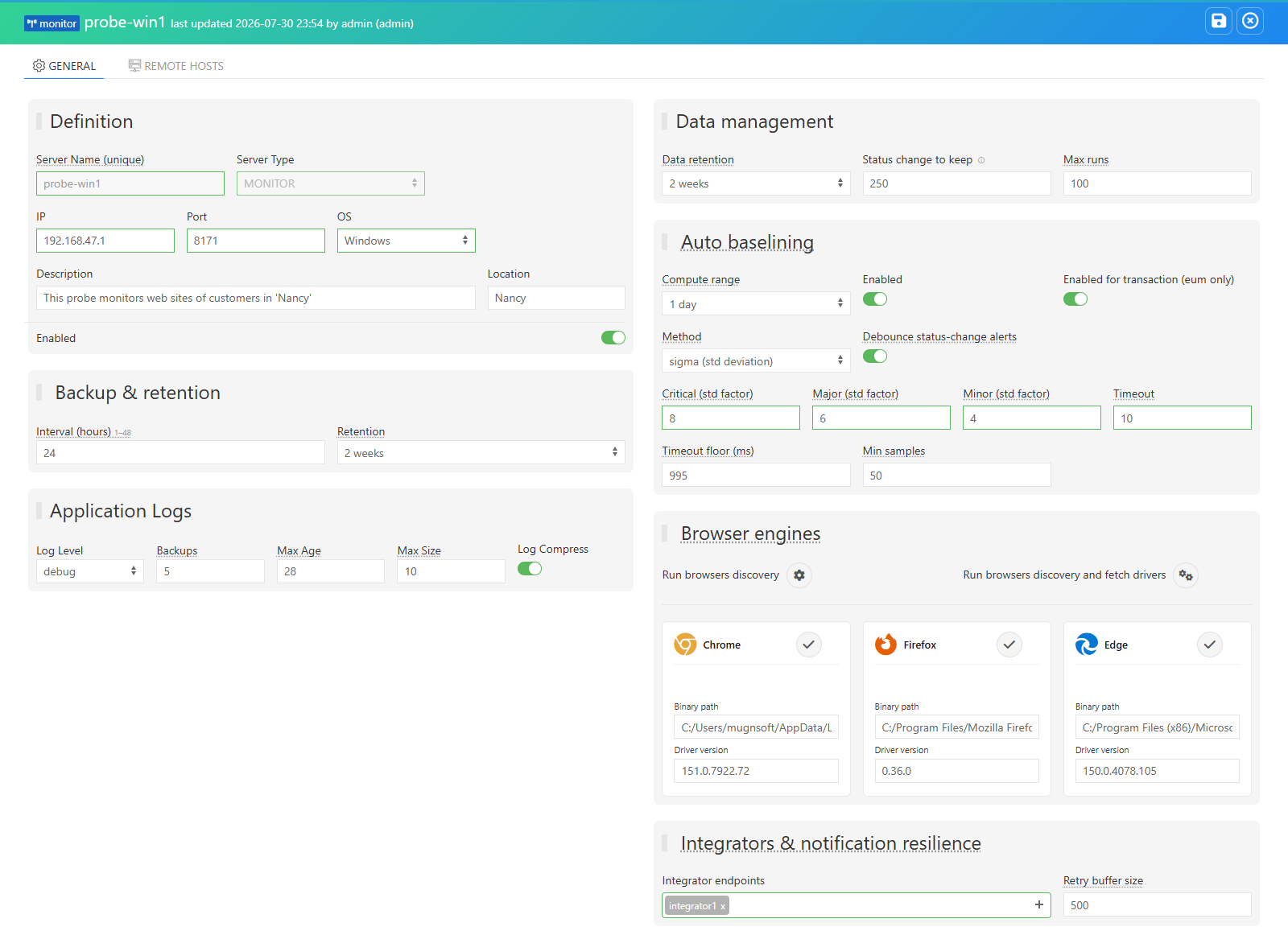
edit server opens the component’s settings full screen. The General tab holds its definition (name, type, IP, port, OS, description, location, enabled), its backup and retention, its log settings and, depending on the type, its processing pipeline. An Integrator also has an External Integration tab with its outputs (Kafka, InfluxDB, Splunk, Elastic, Zabbix, Canopsis, ServiceNow, GLPI, Jira); see Integration. Save with the disk icon.
The Webserver’s own settings open the same way, from its node. See Webserver settings.
Table view
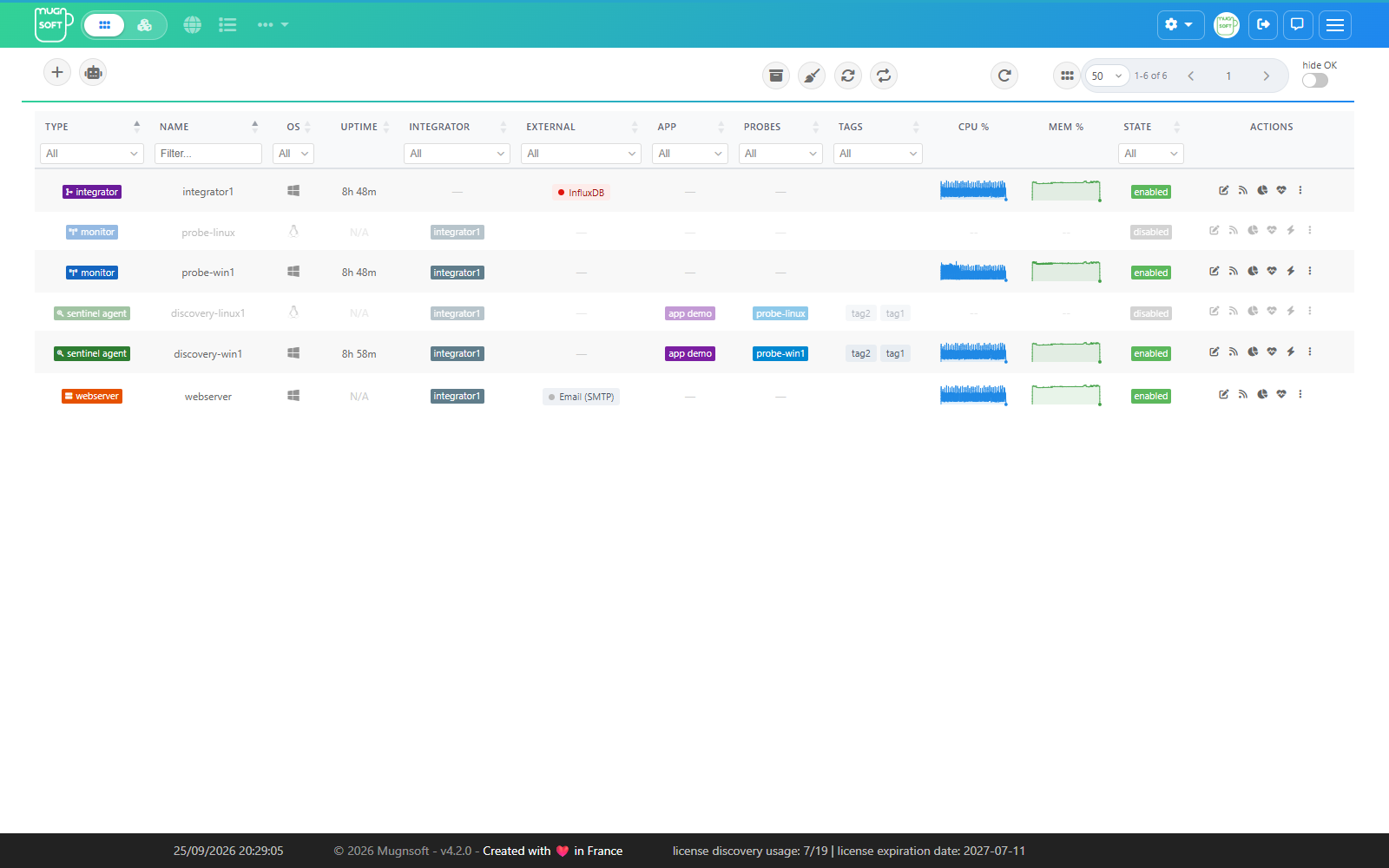
The grid button switches the page to a table: one row per component with its type, name, OS, uptime, integrator, external services, apps, probes, tags, CPU and memory sparklines and state. The last column carries the same actions as the context menu (edit, live view, metrics, health check, compute threshold, and ⋮ for the rest).
Filter components
- In the topology, type in the Search node box;
type:patternrestricts the match to one component type. - In the table view, use the column filters under the headers, the hide OK switch and the page size selector.
See also
- Webserver settings — the Webserver’s own configuration
- Component config builder — generate a component configuration
- Backup — KV store backup and restore
- Components — what each component does